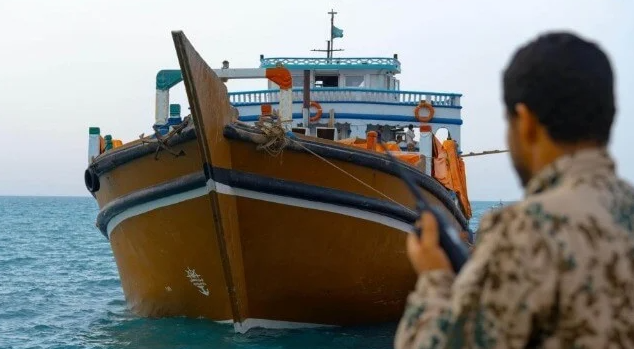
A major arms interception in the Red Sea has shed new light on how Iran’s Islamic Revolutionary Guard Corps (IRGC) has been funnelling weapons to Yemen’s Houthi rebels, according to a report from Yemen’s National Resistance Forces (NRF). This was reported by Maritime Executive.
The revelations stem from the July capture of the Al Sharwa, a stateless dhow carrying some 750 tons of weapons, ammunition, missiles, and components. Unlike many past seizures involving crews of stateless Baluchi sailors with no political affiliation, this vessel had four Houthi-linked crew members. They admitted to receiving military training in Iran at Qods Force camps dedicated to foreign proxy fighters.
Their testimony detailed three main IRGC smuggling routes. The first (known as the “front door” route) involved direct commercial shipments from Bandar Abbas to the port of Salif, often used for volatile rocket fuels. Recent Israeli and U.S. airstrikes have severely disrupted this pathway.
The second relied on mother ships anchored off Somalia, transferring cargo to hired Yemeni fishing boats bound for Houthi-controlled ports. This method mirrors past IRGC activity in the Red Sea using the MV Saviz and later its sister ship MV Behshad, which shifted station to the Gulf of Aden in January 2024.
The third route ran through Djibouti, where front companies used standard commercial channels to disguise arms as legitimate cargo, later shipped via small dhows to Hodeidah and Salif with falsified paperwork and the help of corrupt port officials.
The captured crew reportedly provided a detailed map of the network, including key IRGC and Houthi operatives and corrupt intermediaries. All three routes have since been heavily disrupted, but given the IRGC’s adaptability, observers expect alternative pathways to emerge – albeit with growing operational challenges.
Picture: United States Central Command