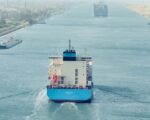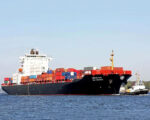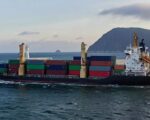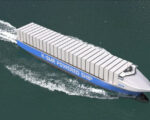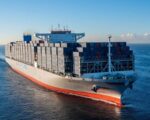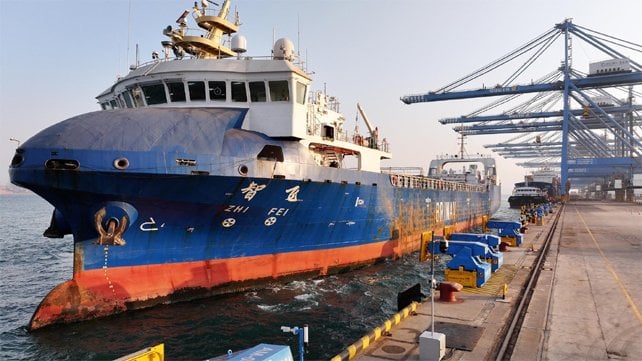
China’s first fully intelligent container vessel, Zhi Fei, successfully completed what officials describe as the world’s first end-to-end autonomous port operations at Qingdao Port. Operations included fully unmanned navigation, automated berthing, vacuum mooring and container handling – all performed without direct human intervention.
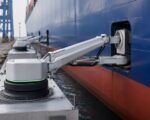
The 300 TEU electric feeder ship navigated autonomously into Qingdao Port before positioning itself alongside the berth. A vacuum-based automated mooring system secured the vessel using suction cups attached to the hull, eliminating the need for traditional mooring lines.
According to reports, the entire mooring process was completed in just 30 seconds, significantly reducing berthing time and manpower requirements.
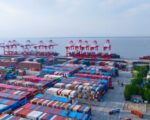
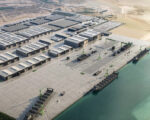
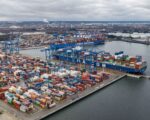
Immediately after berthing, Qingdao’s Automated Terminal Operating System (A-TOS) and Automated Equipment Control System (A-ECS) coordinated intelligent gantry cranes and automated guided vehicles (AGVs) to begin container unloading and transfer operations.
The entire cargo-handling process was executed without delays, demonstrating the viability of fully automated container operations even at high-volume ports.
The Zhi Fei, which entered commercial service in April 2022, operates between Qingdao Port and Dongjiakou, covering distances of up to 89 nautical miles at speeds of 12 knots.
The vessel was designed to operate in three modes: crew-managed navigation, remote-controlled navigation from shore and fully autonomous unmanned navigation.
The company reports the vessel operates with 30% fewer crewmembers compared to conventional ships and reduces human error risk by approximately 80%, generating monthly operating cost savings of around $27,500.
To enable full autonomy, developers overcame several technical challenges, including the creation of domestic radar systems and wave suppression algorithms to eliminate electromagnetic interference. The vessel’s 5G connectivity was optimized in cooperation with China Telecom, China Mobile, and China Unicom to ensure stable communication between the ship and shore stations.
The fully electric propulsion system improves response time and control accuracy, while enhanced battery capacity – increased to 80–90 amp hours from the traditional 50 amp hours – supports operational efficiency.
Chinese officials describe Zhi Fei as a demonstration vessel aimed at advancing intelligent shipping technologies, with future plans to expand autonomous capabilities to larger ocean-going vessels, including LNG carriers.