Bridget Gavin served as a marine engineer on VLCC tankers. Despite being a young mother, she managed to overcome all the challenges of life at sea and became the first woman to serve as Chief Engineer on the world’s largest car ferry. Balancing motherhood and a demanding maritime career, she rose through the ranks to hold the highest engineering position aboard MV Ulysses.
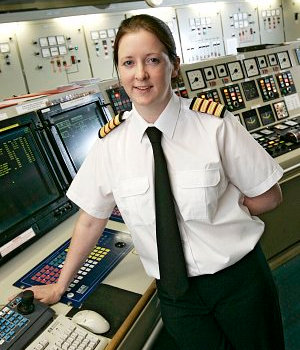
Choosing a career at sea surprised many people – especially her family. They knew they would miss her deeply during long voyages. Her journey began with BP Shipping, where she gained valuable experience on large tankers. Graduates of the National Maritime College of Ireland were always in high demand, and cadets often dreamed of working for companies like Royal Dutch Shell or BP. Bridget served on VLCCs trading between Japan and Australia, the Persian Gulf and the United States, spending about four months at sea per contract.
She recalls that working with BP was an excellent experience: “They were very supportive while I was studying at college and gave me hands-on training onboard. Thanks to their support, I progressed quickly and was promoted to Second Engineer, and by 2007, I had become Chief Engineer.”
Bridget loved her time with BP but later decided to adjust her career to better suit family life. She joined Irish Ferries as Second Engineer aboard Normandy and Oscar Wilde, sailing between Ireland and France. Not long after, she was promoted to Chief Engineer on Ulysses. This schedule was a much better fit (two weeks at sea followed by two weeks ashore) allowing her to balance work and family life.
Today, only two women in Ireland hold a First-Class Chief Engineer Certificate of Competency – and Bridget is one of them. The Maritime Telegraph had the pleasure of speaking with Mrs. Gavin about her remarkable career and her journey in a male-dominated profession.
MT: Why did you choose a maritime career?
I grew up by the sea in a small village on Ireland’s west coast. I had brothers, and I always believed I could do anything they could. That’s how I was raised – to never think of myself as different.
How old were you when you became Chief Engineer, and how long have you worked in this position?
I became Chief Engineer in 2008, when I was 31, working with Irish Ferries. It’s a wonderful company, and I truly enjoyed my time there.
Why did you choose engineering instead of navigation?
For me, seafaring was always more about engineering than about simply being at sea. I’ve always been fascinated by how things work – by solving problems and making systems run smoothly. That’s just how my mind works.
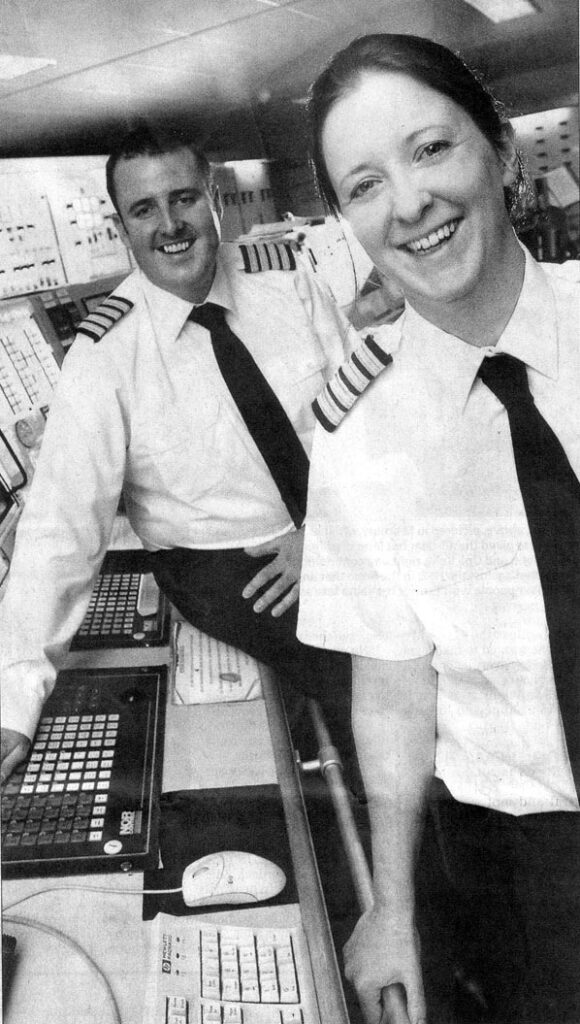
MT: How did your male colleagues treat you?
Throughout my career, I’ve had tremendous support from my male colleagues. Some might be hesitant at first, but once you prove that you know your job, they realize you can perform just as well, and gender no longer matters. I’ve enjoyed my career at sea and made lifelong friends along the way.
MT: Do you remember your first cadet voyage? What impressed you the most?
My first voyage was in 1998. I joined an LNG tanker in Japan as a BP Shipping cadet. The size of the ship was overwhelming at first! It took time to adjust and to get used to life at sea. A steep but fascinating learning curve!
MT: What types of ships have you worked on?
Mostly tankers and ferries. On tankers, I worked with slow-speed diesel engines, but I also had experience on some steam ships – they were incredible from a technical point of view. On ferries, I mostly worked with medium- and high-speed diesel engines.
MT: Have you ever faced extreme situations at sea?
One of the most memorable incidents was when a crankshaft failure completely destroyed one of the main engines. The decision-making was intense – sometimes you have to think on your feet and act fast. Rebuilding the engine took weeks, but it was an incredibly challenging and rewarding experience. Every such moment teaches you something.
MT: What are the main challenges and advantages of a seafaring career for women?
Seafaring can be tough for women. You need a strong character and solid knowledge. I think women constantly have to prove they know what they’re doing, while men don’t face that same pressure. Women have to work harder than men to be taken seriously.
It’s also difficult to balance a career at sea with family life. Having children while working long contracts can be tough. That’s why shorter rotations (like two weeks on, two weeks off) make such a difference. They allow for a normal family rhythm.
In Ireland, some say women aren’t meant for the sea, but our first maritime heroine – Grace O’Malley (Gráinne Mhaol), the Pirate Queen (1530–1603) – broke every rule and proved otherwise. A true Irish legend.
Women bring something unique to shipping. A more human element that creates a positive atmosphere onboard. They contribute immensely to the maritime workforce and can perform every job as capably as men. A career at sea can be rewarding, both personally and financially. It’s a path full of opportunities, both at sea and ashore.
MT: What kind of leadership style do you use with your team? Were you a strict leader?
I’d say I’m a fair leader. I like to lead by example – if you’re willing to get your hands dirty and be part of the team, you’ll earn respect. I was strict about safety and technical standards, because seafaring and engineering can be dangerous if not done properly.
MT: What qualities do you value most in people you work with?
Hard work and honesty. If you have those two traits, everything else can be learned.
MT: Have you worked with Ukrainian seafarers? What do you think of them?
Yes, I have. I really enjoyed sharing stories about our different traditions. Ukrainian seafarers are very professional. I’ve always enjoyed working with them.
MT: What did you love most about your job?
Even though I’m no longer working at sea, I loved meeting people from all over the world and building strong teams. Solving problems and seeing a job well done – that was deeply satisfying.
MT: Do you do household chores that are traditionally seen as “women’s work”?
Of course! I have two kids, so I have to! My husband is great and helps a lot, though I think I’m still better at it. I truly value the time we spend together as a family, sharing meals and stories from our day.
MT: Would you like your children to follow in your footsteps?
If they wanted to go to sea, I wouldn’t stop them. It’s a great life – one that builds strong character and resilience.
MT: How do you balance a happy family life with a successful career?
I haven’t been at sea for the past two years. When my younger daughter turned two, I was offered a shore-based position that suits our family life much better. My husband also worked at sea, so planning vacations together was difficult. We made this decision for our family – and it works for us. If you want to follow your dream, don’t wait for an invitation – just go for it. Work hard, be honest, and believe in yourself!