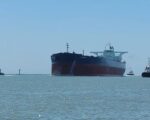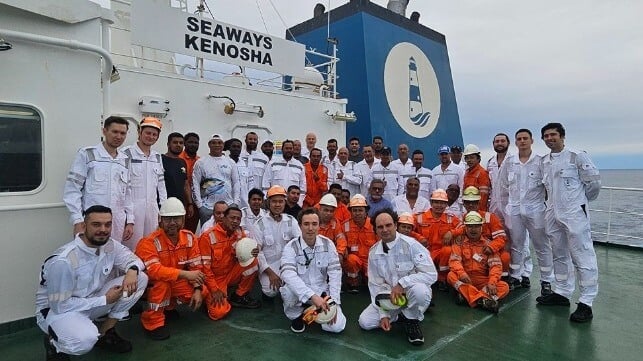
A crew of Liberian-flagged chemical tanker Seaways Kenosha successfully rescued 27 mariners from a life-threatening situation in the Eastern Pacific after their fishing vessel caught fire and sank.
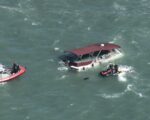
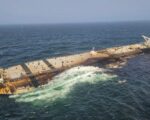
The 240-foot Venezuelan-flagged tuna seiner La Pena experienced a major fire while underway approximately 500 miles north-northwest of the Galapagos Islands on February 1. The crew was forced to abandon ship into a single emergency lifeboat.
At approximately 15:50 LT, the U.S. Coast Guard Rescue Coordination Center (RCC) Alameda, California, received an alert from Garmin, a satellite communications and navigation service provider. Garmin’s operations center had intercepted an SOS distress message transmitted from a handheld satellite messaging device activated onboard the La Pena.
Unlike a conventional EPIRB, the Garmin device supports two-way satellite communications, enabling RCC Alameda watchstanders to establish and maintain real-time text contact with the survivors. According to the information received, after fire La Pena subsequently sank, and all 27 crewmembers were adrift in the lifeboat. They reported having no lifejackets or emergency provisions with them. Their only means of communication was the Garmin device, which at the time had approximately 37% battery remaining and steadily depleting.
To preserve sufficient power for ongoing communications, RCC Alameda instructed the survivors to switch the device off for 90 minutes and then reactivate it to transmit a status update. Concurrently, the Coast Guard initiated efforts to identify nearby merchant vessels capable of rendering assistance. Although the area off the Central American coast is sparsely covered by dedicated SAR assets, it lies close to Panama Canal approaches and established shipping lanes.
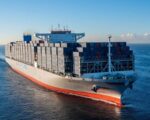
An AMVER system query identified two merchant vessels within a 100-nautical-mile radius. One of them, the tanker Seaways Kenosha, voluntarily agreed to divert from its voyage and proceed to the scene to recover the survivors.
The Seaways Kenosha reversed course and reached the distress position at approximately 03:30 hours on Sunday. Upon arrival, the vessel’s crew conducted a prompt and well-coordinated recovery operation, safely embarking all survivors from La Pena.
All rescued mariners were reported to be in stable condition with no life-threatening injuries. Once the rescue was completed, Seaways Kenosha resumed her commercial passage to La Pampilla, Peru.
The Coast Guard credited the success of the mission to the rapid integration of satellite technology and the voluntary participation of merchant shipping in the AMVER program.