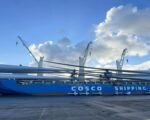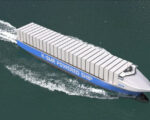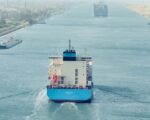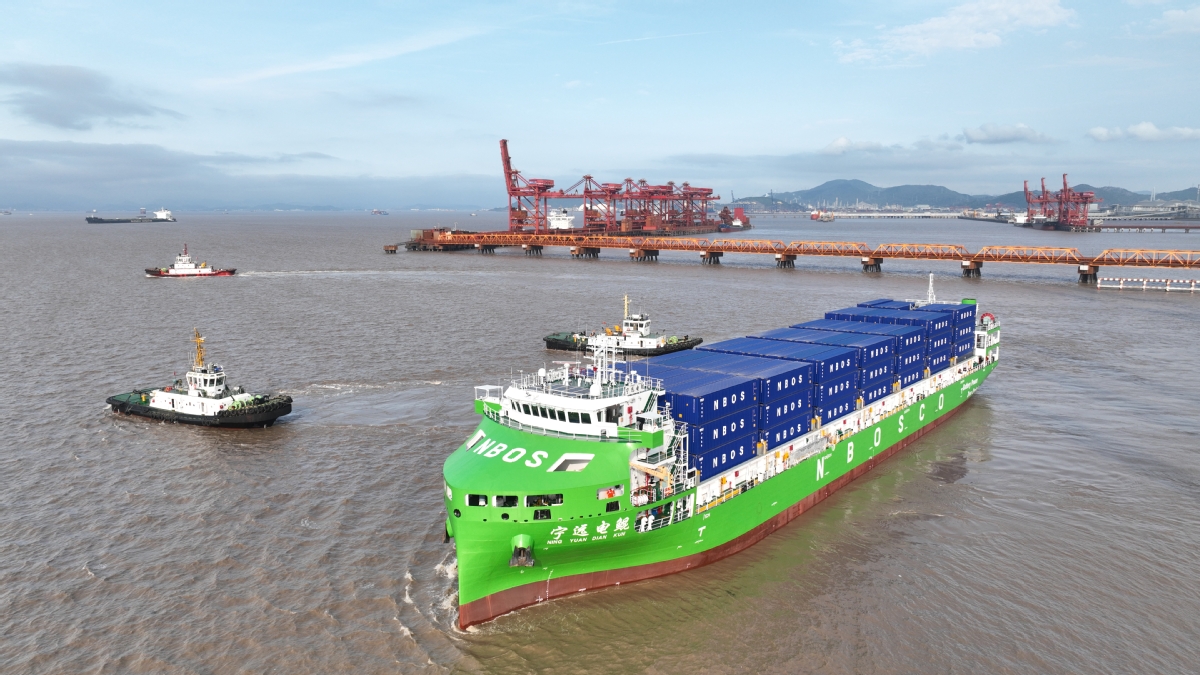
China has launched the world’s largest fully electric and intelligent container ship into commercial service, marking another milestone in the electrification of maritime transport.
The vessel Ning Yuan Dian Kun departed from Ningbo-Zhoushan Port this week on its first operational voyage to Jiaxing, operating on a dedicated coastal route in Zhejiang Province. The ship was independently developed and designed by the Shanghai Merchant Ship Design and Research Institute as part of China’s broader push toward zero-emission shipping.
With a capacity of around 740 TEU, the vessel is powered by 10 standardised battery containers with a total energy storage capacity of nearly 20,000 kWh – roughly equivalent to the batteries of about 300 electric cars. Propulsion is delivered by two 875 kW permanent-magnet motors, enabling fully electric, zero-emission and near-silent operations.
In addition to eliminating emissions of sulfur oxides, nitrogen oxides and particulate matter, the vessel is expected to save approximately 580 tonnes of fuel annually and reduce carbon dioxide emissions by more than 1,400 tonnes per year.
The ship also integrates advanced digital systems, including smart navigation and autonomous collision avoidance, high-precision tracking, and ship–shore–cloud connectivity, reflecting the growing role of intelligent technologies in modern fleet operations.
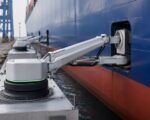
Operational flexibility is supported by a dual-mode charging system, combining high-voltage shore power with rapid battery container swapping. The vessel’s optimised hull design, including a wind-reducing bow, further enhances efficiency by lowering air resistance.
The project is seen as a significant step in scaling battery-powered solutions from inland waterways to coastal shipping. A sister vessel, Ning Yuan Dian Peng, is expected to enter service later this year, supporting the expansion of electric container transport on regional routes.
The launch underscores China’s ambition to lead in both maritime decarbonisation and intelligent vessel development, as the global industry accelerates its transition toward greener operations.