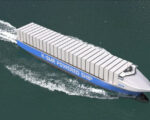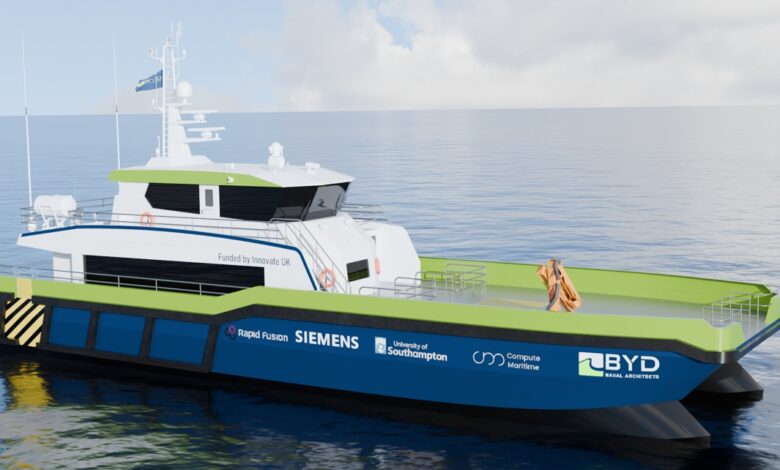
A UK tech company Compute Maritime has revealed what is described as the world’s first сrew transfer vessel designed using artificial intelligence, marking a significant step in the application of generative AI to ship design and maritime decarbonisation.
The 32.5-metre twin-hull crew transfer vessel (CTV) was developed by Compute Maritime using its NeuralShipper AI platform in collaboration with Siemens Digital Industries Software, BYD Naval Architects, Rapid Fusion, HP and the University of Southampton.
According to project data, the AI-optimised design delivers an 11.1% reduction in annual fuel consumption and cuts CO₂ emissions by 258.7 tonnes per vessel per year compared with a conventional diesel-powered equivalent. The vessel is also reported to save more than 101,000 litres of fuel annually.
The design process used generative AI to optimise hull form for offshore wind operational profiles, where vessels perform repeated high-speed transits between shore bases and wind farms. The CTV is designed to carry 24 technicians and four crew, with a service speed of up to 25 knots.
Simulation results indicate that the AI-optimised hull maintains a positive energy balance over a full operating cycle, avoiding the battery deficit seen in conventional baseline designs and ensuring consistent service speed within safe operating limits.
The vessel features a diesel-electric hybrid propulsion system and is prepared for future offshore charging infrastructure, allowing gradual transition toward increased electrification as grid connections expand at wind farm sites.
Compute Maritime said the NeuralShipper platform integrates hydrodynamic simulation, operational modelling and manufacturing constraints into a single design loop, enabling hull geometries that are optimised both for performance and buildability.
The company added that additive manufacturing compatibility was built into the process, allowing components such as hydrofoils to be designed for direct production using robotic large-format 3D printing systems without redesign for fabrication.
Project partners describe the development as a shift toward intelligence-led shipbuilding, where AI tools are used not only for optimisation but also to explore entirely new design spaces within real operational constraints.
The project aligns with broader UK maritime decarbonisation goals, where crew transfer vessels are considered a key segment due to their high utilisation in offshore wind operations and significant cumulative fuel consumption.
If adopted at scale, AI-driven vessel design could reshape offshore shipping development by shortening design cycles and improving efficiency across both existing and next-generation support fleets.