India has confirmed the deaths of three seafarers aboard the product tanker Settebello, while U.S. forces have carried out a strike against a third tanker crewed by Indian nationals this week, further intensifying concerns over the safety of merchant mariners operating in the Gulf of Oman.
Indian Shipping Minister Sarbananda Sonowal said on June 11 that three Indian crew members previously reported missing after the attack on Settebello had been found dead and identified.
The confirmation revises earlier reports that indicated one fatality and two missing seafarers following the incident. According to Indian maritime unions, the victims included the vessel’s chief engineer, an engine fitter and a deck cadet.
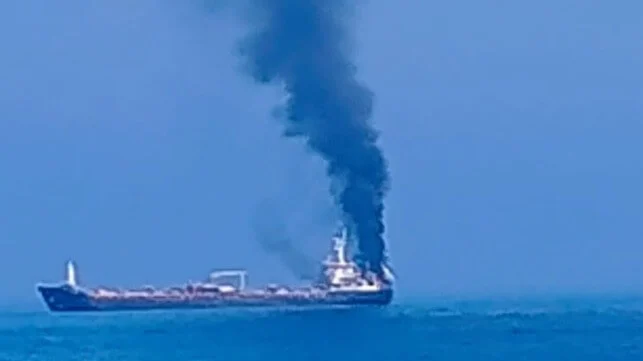
The Palau-flagged product tanker Settebello was struck on June 10 after U.S. Central Command (CENTCOM) accused the vessel of violating the ongoing blockade of Iranian oil exports. According to the U.S. military, an aircraft fired precision munitions into the tanker’s engine room after the crew allegedly failed to comply with instructions from American forces.
The vessel subsequently reported a major engine room fire, prompting an evacuation operation involving Omani authorities. Twenty-one Indian crew members were rescued.
The deaths represent the first confirmed seafarer fatalities linked to U.S. blockade enforcement operations launched in April.
Just one day later, U.S. forces disabled another tanker, Jalveer, in the Gulf of Oman. CENTCOM said the 6,395-dwt bitumen tanker was targeted after allegedly attempting to transport Iranian oil in violation of the blockade. According to the military, two Hellfire missiles were fired into the vessel’s engine room after repeated warnings were ignored.
The Guinea-Bissau-flagged tanker was operating with a crew of 20 Indian nationals. All were safely evacuated ashore with assistance from Omani authorities, and no casualties were reported.
The latest incident marks the third tanker involving Indian seafarers to be targeted by U.S. forces this week. Earlier, the tanker Marivex was also disabled during a separate blockade enforcement operation. All crew members aboard that vessel were rescued.
The succession of incidents has placed Indian seafarers at the center of the maritime crisis unfolding around the Strait of Hormuz and Gulf of Oman. India supplies one of the world’s largest pools of merchant mariners, with more than 300,000 seafarers serving aboard international fleets.
New Delhi has reacted sharply to the developments. Indian authorities condemned the attack on Settebello and reportedly lodged a formal protest with U.S. diplomats following both incidents. The Indian government has called for de-escalation and stressed that commercial shipping and civilian seafarers must not become casualties of the regional conflict.
Questions also remain over the vessels’ alleged links to Iranian oil exports. While CENTCOM maintains that both Settebello and Jalveer were engaged in activities that violated the blockade, representatives of Settebello’s management have rejected the allegations, insisting the vessel was conducting legitimate commercial operations and had not ignored any instructions from U.S. forces.