Japan has reported a major technological milestone in maritime decarbonization with the successful testing of a large hydrogen-fueled engine designed for ocean-going commercial vessels.
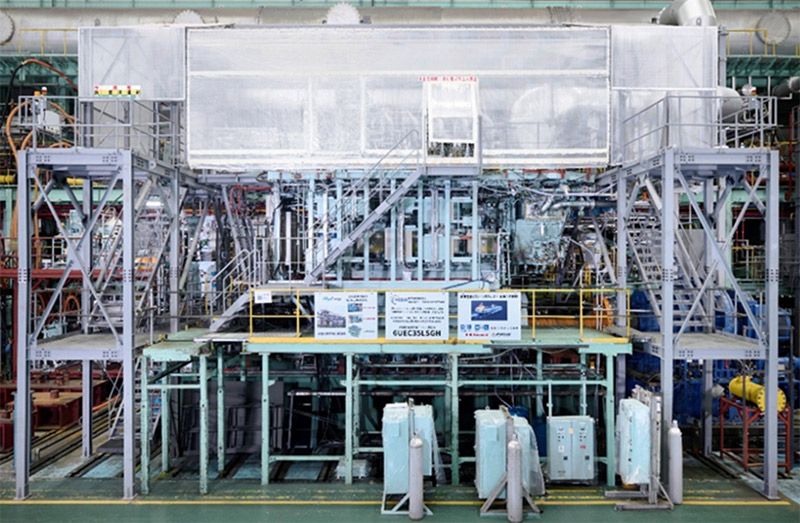
The engine, developed by Japan Engine Corporation in cooperation with Kawasaki Heavy Industries, is a low-speed, two-stroke unit intended to serve as the main engine for deep-sea ships. This marks a significant shift from earlier hydrogen projects, which have largely focused on small vessels operating on short coastal routes.
According to the developers, most existing hydrogen applications in shipping are limited to low-output operations, such as tugboats or sightseeing vessels using compressed hydrogen. In contrast, the new engine is designed for long-distance voyages and heavy cargo operations.
Factory tests have demonstrated stable operation with a hydrogen co-firing ratio exceeding 95 percent at full load, confirming both the feasibility of the technology and its potential to significantly reduce greenhouse gas emissions. Further verification testing is planned to optimize performance under various operating conditions.
The project is being carried out under a government-backed program led by Japan’s New Energy and Industrial Technology Development Organization (NEDO). In addition to the engine, the partners are developing a full hydrogen fuel system, including onboard storage and supply infrastructure.
The engine is scheduled for delivery in January 2027 and will be installed on a 17,500 dwt multipurpose vessel designed by Onomichi Dockyard. The vessel will be operated by Mitsui O.S.K. Lines (MOL) and MOL Drybulk.
Once completed, the ship is expected to enter a three-year demonstration phase starting in 2028, aimed at validating hydrogen as a viable alternative fuel for large commercial shipping.
The developers believe this is the first engine of its kind, representing a key step toward scaling hydrogen propulsion for deep-sea vessels.