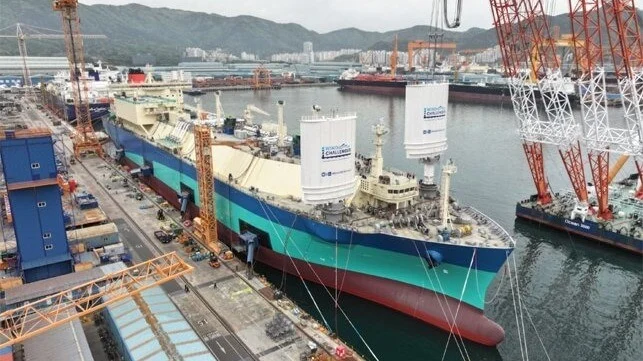
Japanese shipping company Mitsui O.S.K. Lines (MOL) and South Korean shipbuilder Hanwha Ocean have completed the first installation of rigid wind sails on an LNG carrier currently under construction in South Korea.
The vessel will become the world’s first LNG carrier equipped with the Wind Challenger system, a telescopic rigid sail technology developed by MOL together with Japan’s Oshima Shipbuilding.
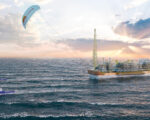
Images released by Hanwha Ocean show two large solid sails mounted near the bow of the LNG carrier as construction approaches its final stages. The vessel was ordered in 2024 under a long-term agreement involving MOL and Chevron Shipping and is scheduled for delivery in 2026.
Each sail consists of three telescopic panels made from fiber-reinforced plastic. When fully extended, the structures rise about 49 meters above deck level and measure approximately 15 meters in width.
MOL previously introduced the Wind Challenger system aboard a coal carrier delivered in 2022 and has since expanded the technology to additional bulk carrier newbuildings and retrofit projects. The LNG carrier installation marks the first application of the system on a gas carrier.
Before proceeding with the project, MOL, Hanwha Ocean, and classification society ClassNK conducted safety and operational assessments covering sail placement, bridge visibility, emergency procedures, and interaction with LNG cargo containment systems.
French LNG containment specialist GTT also participated in the evaluation process to assess the impact of sail installation on the vessel’s membrane cargo tanks. Following the review, ClassNK granted Approval in Principle for the LNG carrier design.
The vessel will reportedly have a cargo capacity of approximately 174,000 cubic meters of LNG and will be powered by an Everllence main engine supplied by MAN Energy Solutions.
MOL has previously said that LNG carriers equipped with two Wind Challenger sails could reduce fuel consumption and emissions by up to 12 percent per voyage, depending on weather and operating conditions.
The company is also preparing a second LNG carrier equipped with the same technology under a separate long-term charter arrangement with Tokyo LNG Tanker Company.
The project reflects growing industry interest in wind-assisted propulsion systems as shipowners seek additional methods to reduce fuel consumption and comply with tightening emissions regulations. While rigid sails remain relatively uncommon in mainstream commercial shipping, installations have increased steadily across bulk carriers, tankers, and specialized vessels in recent years.