The International Code of Signals (ICS) is a universal system of signs and codes created to ensure clear communication between ships, especially in matters of safety and navigation. Messages can be transmitted through flag hoists, signal lamps, radiotelegraphy, radiotelephony, and (perhaps most fascinating of all) flag signaling.
A brief history
In the early days of seafaring, the meaning of a flag signal depended entirely on where it was raised. The first attempts to standardize and regulate flag messages date back to the 17th century. In 1653, Britain published the very first collection of naval flag signals. At the time, a signal’s meaning could depend on more than just the flag’s design – its position on the mast, or even the number of cannon shots or sail configurations, could alter its intent.
By 1780, the British Navy decided to simplify the system to just ten signaling flags. Then, in 1800, Captain Home Riggs Popham compiled a “Marine Vocabulary,” a book decoding over 2,000 flag combinations. The Royal Navy officially adopted Popham’s system in 1803, and naval signaling became a hallmark of military communication.
In the early 19th century, Frederick Marryat developed a separate Code of Signals for the Merchant Service. It consisted of 15 flags and pennants, used primarily by British merchant ships. As international trade expanded, so did the need for a shared maritime language. By 1887, major seafaring nations agreed upon the International Code of Signals, an expanded version of Marryat’s system, which officially came into force on January 1, 1901.
A revision in 1931 streamlined the system for practicality. The latest update, introduced on April 1, 1969, added Cyrillic transliterations. Today, the Code includes 26 alphabet flags, 10 numeral pennants, and 3 substitute flags.
How It Works
Signal flags are brightly colored symbols (square or triangular) used singly or in combination to convey specific messages. The set includes 26 letter flags, ten numeral pennants, one answering pennant, and three substitutes. Each flag has a unique meaning. For example, the “O” (Oscar) flag means “Man overboard,” while the “B” (Bravo) flag signals that a vessel is loading or discharging dangerous cargo such as explosives.
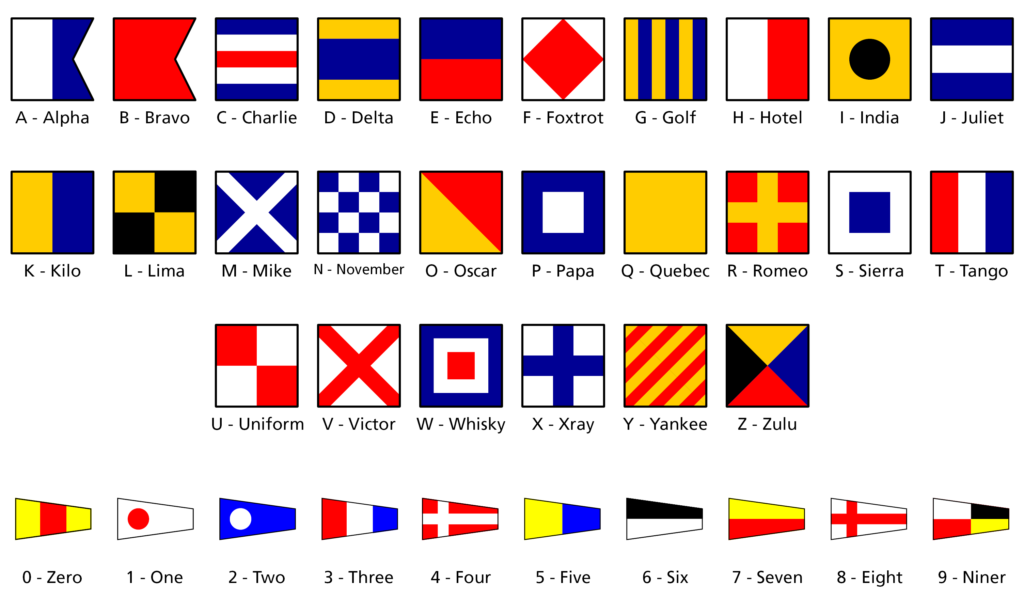
Only a few colors are clearly distinguishable at sea – red, blue, yellow, black, and white. They are carefully combined for maximum visibility. You’ll notice patterns such as red and white, blue and yellow, or solid colors like pure red or white, designed to stand out against the horizon. A single flag typically conveys urgent or routine messages. Two flags often indicate maneuvering or distress signals. Three flags can represent directions, times, or general codes, while four or more identify ships, locations, or coordinate data. In some cases, a seven-flag signal may even specify a longitude of over 100 degrees.
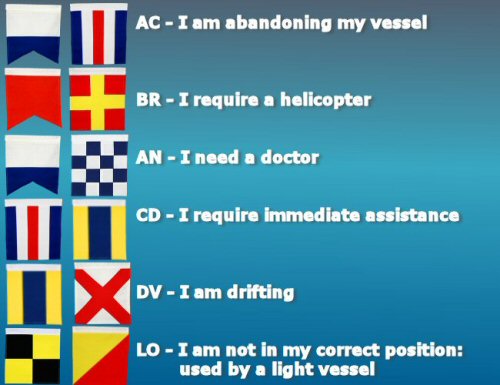
Experienced mariners could easily recognize one-flag messages, but more complex groups required a codebook for decoding. For instance, the signal KT meant “You should send me a tug,” while KT1 changed the meaning to “I am sending a tug.” Similarly, CB meant “I require immediate assistance,” whereas CB4 meant “I require immediate assistance; I am aground.”
Legacy in the modern world
In today’s era of instant satellite communication, the art of flag signaling has all but faded into maritime history. Yet some traditional signals, such as the “Blue Peter” (P flag, meaning a ship is about to sail), remain in use.
Unlike the semaphore system, the International Code of Signals has never been abolished by the International Maritime Organization (IMO). It endures as a symbol of seafaring heritage, a timeless language that once allowed ships from every nation to communicate safely – long before radio waves united the oceans.