The International Maritime Organization (IMO) has adopted the world’s largest Emission Control Area (ECA), tightening air pollution limits for ships across the North-East Atlantic in a major regulatory step for global shipping.
The decision was formalized during the 84th session of the Marine Environment Protection Committee (MEPC 84) in London, following a joint proposal backed by 27 EU member states along with the United Kingdom, Iceland, and the European Commission. According to the IMO, the new ECA will enter into force in September 2027 and become fully effective in 2028.
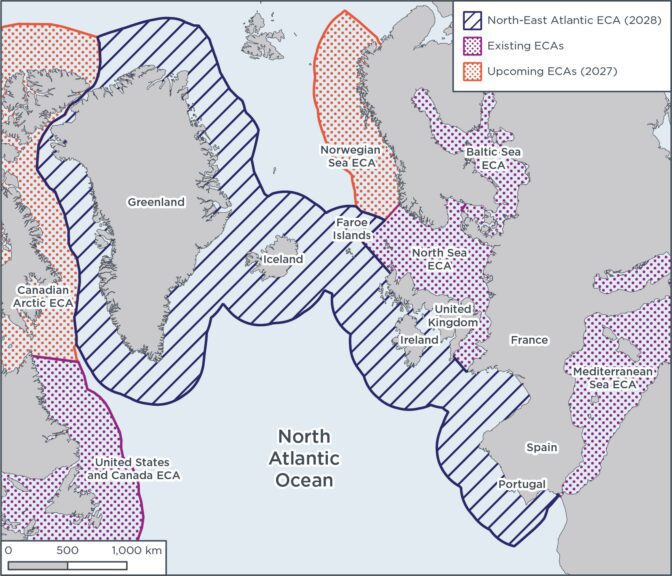
The North-East Atlantic ECA will cover waters extending up to 200 nautical miles from the coast, spanning from Greenland and Iceland in the north to Portugal and Spain in the south, including the exclusive economic zones of several major European maritime nations. The zone will also connect existing ECAs in the Baltic Sea, North Sea, and Mediterranean with newly designated areas in the Norwegian Sea and Canadian Arctic.
Under the new regime, ships operating within the ECA will be required to use fuel with a sulfur content of no more than 0.10 percent or adopt equivalent compliance solutions such as exhaust gas cleaning systems (scrubbers) or alternative low-emission fuels like LNG. In addition, stricter nitrogen oxide (NOx) limits will apply to vessels built from January 2027 onwards.
Industry and research organizations have highlighted the potential impact of the measure. The International Council on Clean Transportation (ICCT), which contributed technical analysis to support the proposal, estimates that the new ECA could reduce sulfur oxide emissions by up to 82 percent and fine particulate matter by 64 percent. Over time, NOx emissions could fall by as much as 71 percent as newer vessels enter the fleet.
These reductions are projected to deliver significant public health benefits. According to ICCT modelling, the measure could prevent more than 4,000 premature deaths and generate up to €29 billion in health-related cost savings by 2050, while also reducing black carbon emissions linked to Arctic warming.
Beyond air emissions, MEPC 84 also advanced several additional environmental initiatives. The IMO adopted an updated strategy to address marine plastic litter from ships, focusing on improving port reception facilities and waste management systems. The committee also agreed to develop mandatory regulations governing the transport of plastic pellets in containers, following a series of high-profile pollution incidents.
Amendments to the Ballast Water Management Convention were approved, including revised guidelines and updated requirements for ballast water management plans. Work on underwater radiated noise was also extended, with member states agreeing to prolong the experience-building phase through 2028 to better address implementation challenges.
While progress was made on these fronts, discussions at MEPC 84 were also marked by delays and political disagreements on other agenda items, reflecting the complexity of aligning environmental regulation across a global industry.
For ship operators, the adoption of the North-East Atlantic ECA represents a significant expansion of regulated waters, increasing compliance requirements across one of the world’s busiest trade corridors. The measure reinforces a broader trend toward tighter emissions control and signals continued regulatory pressure on fuel quality, engine performance, and environmental impact in international shipping.